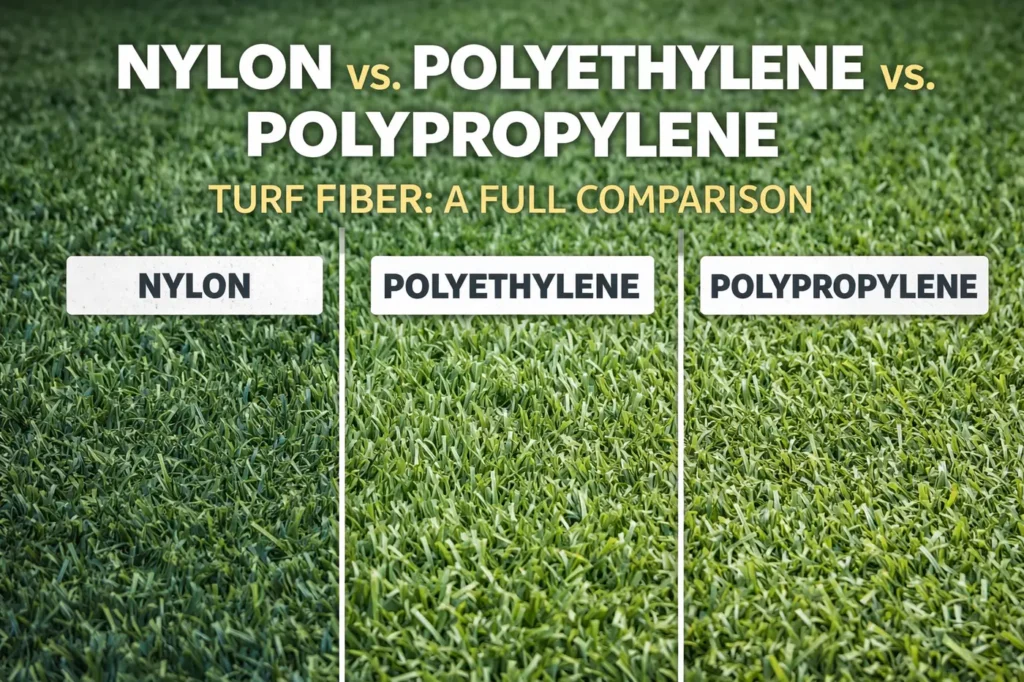
If you’ve spent any time shopping for artificial turf, you’ve probably noticed that product specs mention fiber type (nylon, polyethylene, or polypropylene) without much explanation of what that actually means for your project. These three materials behave very differently from one another, and choosing the wrong one for your application can lead to premature wear, poor aesthetics, or a product that simply wasn’t built for how it’ll be used.
This guide breaks down what each fiber is, how it performs across the factors that matter most, and which applications each is best suited for.
A Brief History
The fiber question has been part of the artificial turf industry since its very beginning. The first synthetic turf surface was installed at the Houston Astrodome in the 1960s and was made from nylon, the strongest synthetic fiber available at the time. It was the obvious choice for a high-traffic professional sports surface. Since then, polyethylene emerged as a softer, more realistic-looking alternative, and polypropylene entered the market as a budget-friendly option. Today, all three are still in use, though each has settled into a fairly distinct role.
The Three Fiber Types, Explained
Nylon
Nylon is the original artificial turf fiber and still the strongest of the three. It’s a synthetic polyamide polymer, the same material used in parachute cord, fishing lines, and industrial carpeting. These are products specifically chosen for tensile strength and resilience.
In turf applications, nylon’s defining characteristic is its ability to spring back. Blades hold their upright position under heavy, repeated traffic better than either of the other two fibers. Nylon is approximately 40% more resilient than polyethylene and 22% more resilient than polypropylene, meaning fibers recover their shape after compression from foot traffic, furniture, or equipment.
Nylon also has the highest melting point of the three materials, at around 460 degrees Fahrenheit, which matters in hot climates or installations near Low-E reflective windows. Polyethylene softens at 248 to 266 degrees, and polypropylene can begin to degrade at temperatures above 214 degrees, temperatures that concentrated window reflection or extreme direct sun can realistically reach.
The tradeoffs with nylon are real, though. Its stiffness means it lacks the soft, natural feel of polyethylene, and it is the most likely of the three to cause abrasion on skin during falls — a well-known issue in sports applications called “turf burn.” It is also semi-permeable, meaning it absorbs water more readily than the other two, which can be a drawback for pet installations where odor retention is a concern. And it is, by a meaningful margin, the most expensive fiber to manufacture.
Nylon is best suited for: putting greens, rooftop installations, high-traffic commercial applications, sports surfaces where heavy cleated footwear is not in use.
Polyethylene
Polyethylene is the most widely used fiber in the industry today, and for good reason. It strikes a balance between softness and durability that makes it suitable for a wide range of applications, from residential lawns to commercial landscapes to pet areas.
Visually, polyethylene is the most realistic of the three fibers. The material can be produced in varied blade widths, natural matte finishes, and multi-tone colorways that closely mimic real grass. Unlike nylon, which tends to look obviously synthetic, or polypropylene, which can have a slightly shiny surface, polyethylene products are generally the hardest to distinguish from natural turf at a glance.
It is also the most pet-friendly option. Polyethylene is highly resistant to water absorption, which means it resists holding onto pet odors in a way that semi-permeable nylon does not. When combined with a quality infill, polyethylene turf performs well in pet-heavy environments.
The main limitation of polyethylene is that it is not as resilient as nylon under sustained heavy use. Under heavy foot traffic, polyethylene blades can flatten and mat down, requiring periodic brushing to restore their upright position. For moderate residential use this is rarely a significant issue, but it’s worth factoring in for high-traffic commercial applications or spaces that see intense, concentrated activity.
Polyethylene is best suited for: residential lawns, putting greens, pet areas, pool surrounds, commercial landscaping, play areas with moderate to heavy use.
Polypropylene
Polypropylene is the lowest-cost fiber of the three, and that’s both its main appeal and the context for understanding its limitations.
As a material, polypropylene is versatile and widely used in manufacturing, from food packaging to automotive components. In artificial turf, it produces a lightweight, flexible blade that can look quite realistic at lower pile heights. It is highly moisture-resistant, which is a genuine advantage, and it is commonly used in turf backing materials across all product types, including those with nylon or polyethylene face fibers.
Where polypropylene runs into trouble is durability and heat. It is the least abrasion-resistant of the three fibers, meaning it wears down faster under traffic and is more prone to flattening, particularly at taller pile heights. Its UV resistance is also the weakest of the three, and without UV-protective additives in the manufacturing process, it can begin to break down and fade in direct sun exposure over time. When buying polypropylene turf, it is worth confirming that UV stabilizers have been blended in.
Polypropylene also has the lowest heat tolerance. At temperatures above 214 degrees Fahrenheit, the material can begin to degrade, making it a poor choice for hot climates or any installation where concentrated heat from reflective surfaces is a possibility.
It is worth noting that polypropylene is commonly found in the secondary thatch layer of many mid-range products, the curly base fibers that support the upright face blades. Using polypropylene as a secondary thatch rather than nylon or polyethylene is one of the ways manufacturers reduce product cost, and it’s a useful thing to check when comparing products side by side.
Polypropylene is best suited for: low-traffic areas, temporary installations, budget-conscious projects in mild climates, backing applications across all product types.
Side-by-Side Comparison
| Property | Nylon | Polyethylene | Polypropylene |
| Durability | Highest | Moderate | Lowest |
| Resilience (spring-back) | Highest | Moderate | Lowest |
| Softness underfoot | Lowest | Highest | Moderate |
| Realistic appearance | Moderate | Best | Moderate |
| UV resistance | Best | Moderate | Lowest |
| Melting point | ~460°F | 248-266°F | Degrades above 214°F |
| Water/odor resistance | Lower | Highest | High |
| Pet suitability | Lower | Best | Moderate |
| Relative cost | Highest | Mid-range | Lowest |
| Typical use case | Sports, putting greens, commercial | Residential lawns, pets, landscaping | Low-traffic, budget installs, backing |
Fiber Blends: Getting the Best of Multiple Materials
It is increasingly common for manufacturers to produce turf products that combine fiber types rather than rely on a single material throughout. The most effective pairing is a polyethylene face fiber with a nylon secondary thatch. This combination gives the lawn the soft, realistic look of polyethylene on the surface with the structural support and resilience of nylon underneath, resulting in a product that performs better than either material would alone.
When reviewing product specs, look for details on both the face fiber and the thatch fiber. A product listed simply as “polyethylene” may have a nylon thatch (a quality indicator) or a polypropylene thatch (a cost-reduction measure). These are different products with meaningfully different performance characteristics.
What Contractors Should Know
For contractors specifying products for clients, fiber type is one of several factors that determines long-term performance, and it often becomes the source of callbacks when the wrong material is selected for the application.
A few practical notes:
For sports applications, nylon remains the standard for putting greens and rooftop surfaces. For full-contact sports fields (football, rugby, soccer) the industry has largely moved toward monofilament polyethylene systems with appropriate infill, since nylon’s abrasiveness creates unacceptable skin injury rates in those environments.
For pet-heavy residential installs, polyethylene with an antimicrobial infill is generally the spec to reach for. Nylon’s semi-permeability makes odor management significantly harder in these environments.
For budget-driven commercial projects, polypropylene products are available but come with lifecycle trade-offs that should be communicated clearly to the client. A shorter replacement cycle can easily erase the upfront cost savings.
For hot climates or installations near reflective windows, nylon’s heat tolerance is a genuine functional advantage, not just a spec-sheet distinction. Reflected heat from Low-E glass windows can exceed the softening point of polyethylene and polypropylene, causing surface deformation that is not covered under most manufacturer warranties.
What Homeowners Should Know
The fiber conversation can feel technical, but the practical questions are fairly simple.
If softness and natural appearance are your priorities and your lawn gets normal residential foot traffic, polyethylene is almost certainly the right choice. It is the most commonly installed fiber for good reason.
If you have kids or pets who will be on the lawn constantly and you want minimal maintenance, look for a polyethylene product with a nylon secondary thatch. You’ll get a softer surface that holds up better over time.
If you are installing a putting green or a rooftop terrace that needs to hold up to furniture and concentrated use without any brushing or maintenance, nylon is worth the premium.
If you are seeing polypropylene products at significantly lower price points, be aware that the cost difference reflects a real difference in lifespan and performance, particularly in warmer climates.
Sources: Paradise Greens, Neograss, Biltright Turf, Artificial Turf Supply, Almost Grass, Total Landscape Care, Keystone Sports Construction, Global Syn-Turf.