If you’ve ever looked at your summer water bill and winced, you’re not alone. For homeowners in drought-prone states, lawn irrigation isn’t just an inconvenience. It’s a significant ongoing expense. Switching to artificial turf eliminates that cost almost entirely, and when you run the numbers, the savings are substantial.
Here’s a straightforward breakdown of what homeowners in six of the driest, highest-demand states in the country can realistically expect to save.
First, the Baseline: How Much Water Does a Natural Lawn Actually Use?
Before we get into state comparisons, it’s worth understanding what you’re working with.
According to the EPA, landscape irrigation accounts for nearly one-third of all residential water use in the U.S., totaling roughly 9 billion gallons per day nationally. In drier climates like the Southwest, that figure climbs even higher, with outdoor watering representing up to 60% of a household’s total water consumption.
The standard watering guideline for a healthy lawn is around 1 inch of water per week. That translates to approximately 0.623 gallons per square foot per watering. For a typical 1,500 sq ft lawn, that’s roughly 935 gallons every time you water, week after week, through a six to eight month growing season.
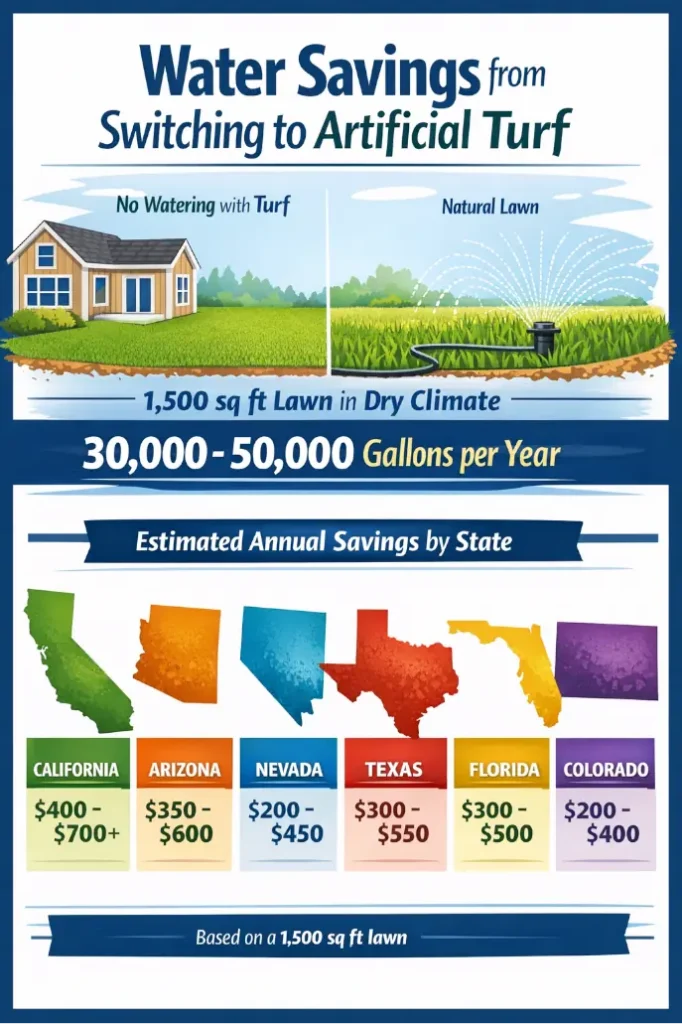
Over a full year, a 1,500 sq ft lawn in a hot, dry climate can consume anywhere from 30,000 to 55,000 gallons just for irrigation.
Artificial turf requires zero ongoing irrigation. The savings below are based on a 1,500 sq ft lawn, using published state average water rates and regional watering season estimates.
State-by-State Water Savings Breakdown
California
Avg. monthly water bill: ~$76 | Watering season: 8-10 months
California consistently ranks among the most expensive states for water in the country. With tiered pricing structures that penalize high-volume users and ongoing drought conditions, lawn irrigation here is costly.
A 1,500 sq ft lawn irrigated weekly through a 9-month season uses roughly 37,000 to 40,000 gallons per year for outdoor use alone.
Estimated annual savings from switching to artificial turf: $400-$700+
On the regulatory side, California passed AB 1572 in 2023, which bans the use of potable water to irrigate non-functional decorative grass at commercial, institutional, and HOA properties, rolling out in phases starting in 2027. It’s a sign of where water policy is heading and why making the switch sooner rather than later makes sense.
Arizona
Avg. monthly water bill: ~$53 | Watering season: 9-11 months
Arizona’s long, hot summers mean lawns need irrigation for the better part of the year. Phoenix uses a tiered pricing model where higher usage is charged at a premium, so large lawns aren’t just thirsty. They’re expensive at the margins.
Homeowners in Arizona irrigating a 1,500 sq ft lawn can expect to use 40,000 to 50,000 gallons annually for outdoor watering.
Estimated annual savings from switching to artificial turf: $350-$600
Several Arizona municipalities offer rebates to homeowners who remove natural grass. Cities like Gilbert offer up to $2,000 for residential grass removal, and Tempe offers $0.50 per square foot converted, up to $2,000. These programs can meaningfully offset the upfront cost of a turf installation. Just make sure to apply before the grass is removed, as most programs require a pre-inspection.
Nevada
Avg. monthly water bill: ~$26-$40 | Watering season: 8-10 months
Nevada’s base water rates are lower than neighboring California and Arizona, but the Southern Nevada Water Authority has taken some of the most aggressive conservation steps in the country. Nevada passed AB 356 in 2021, making it the first state in the nation to permanently ban non-functional grass at commercial, government, and multi-family properties. The law is projected to save 7 to 10 billion gallons of water per year in the region.
For existing homeowners, the savings on turf are real. A 1,500 sq ft lawn here could use 35,000 to 45,000 gallons per year on irrigation.
Estimated annual savings from switching to artificial turf: $200-$450
The Southern Nevada Water Authority also runs a Water Smart Landscapes rebate program offering cash incentives for homeowners who convert turfgrass to water-efficient landscaping.
Texas
Avg. monthly water bill: ~$55-$70 | Watering season: 7-9 months
Texas is a big state with varying climates. Dallas and Austin sit in semi-arid zones that require significant supplemental irrigation, while humidity in Houston means shorter seasons but still substantial summer watering. Tiered pricing is increasingly common across Texas cities following recurring drought declarations.
A 1,500 sq ft lawn in central or north Texas likely consumes 30,000 to 45,000 gallons per year in irrigation.
Estimated annual savings from switching to artificial turf: $300-$550
Florida
Avg. monthly water bill: ~$45-$60 | Watering season: Year-round in south FL; 6-8 months in north FL
Florida might seem wet, but rainfall is heavily seasonal and concentrated in summer storms. Outside of hurricane season, supplemental irrigation is necessary for much of the year. Research from the University of Florida found that in some Florida counties, the highest water users devote 60 to 70% of their total water consumption to irrigation.
For a 1,500 sq ft lawn in South Florida that’s irrigated year-round, annual water use for the lawn alone can exceed 45,000 gallons.
Estimated annual savings from switching to artificial turf: $300-$500
Colorado
Avg. monthly water bill: ~$50-$65 | Watering season: 5-7 months
Colorado’s water situation is shaped by its high altitude and position in the upper Colorado River Basin. Denver Water uses a benchmark of 12 gallons per square foot of landscape per year for efficient outdoor water use. For a 1,500 sq ft lawn, that works out to 18,000 gallons under ideal conditions, though real-world usage is typically higher. Bluegrass turf, common in Colorado, tends to drink more and requires deeper, more frequent watering than drought-tolerant alternatives.
Estimated annual savings from switching to artificial turf: $200-$400
The Bigger Picture
| State | Avg. Annual Lawn Water Use (1,500 sq ft) | Est. Annual Savings |
| California | 37,000-40,000 gal | $400-$700+ |
| Arizona | 40,000-50,000 gal | $350-$600 |
| Nevada | 35,000-45,000 gal | $200-$450 |
| Texas | 30,000-45,000 gal | $300-$550 |
| Florida | 40,000-50,000 gal | $300-$500 |
| Colorado | 18,000-30,000 gal | $200-$400 |
These figures represent water costs only. Factor in eliminated irrigation system maintenance, no more fertilizer or seasonal lawn treatments, and the time savings of zero mowing, and the full value of switching becomes significantly higher.
What About the Upfront Cost?
Artificial turf typically costs between $7 and $20 per square foot installed, meaning a 1,500 sq ft project runs $10,500-$30,000. That sounds steep, but when you factor in annual water savings of $300-$700, eliminated lawn maintenance costs ($1,000-$2,500/year for mowing, fertilizing, and aerating), potential municipal rebates in CA, AZ, and NV, and a product lifespan of 15-20 years, most homeowners in these states reach full payback within 4-8 years, with a decade-plus of savings after that.
A Note on Water Rates
Water pricing varies significantly within states, not just between them. A homeowner in Los Angeles will pay differently than one in Sacramento. Tiered pricing structures also mean that heavy water users save disproportionately more when they switch to turf, since they’re often paying premium rates for that top tier of usage.
For a personalized savings estimate, check your most recent utility bill for your cost per 1,000 gallons (or per CCF), then use the formula: lawn sq ft x 0.623 x number of annual waterings / 1,000 x your rate.